Structural validation
Track refreshes, schemas, required fields, data types, and source-level completeness.
Enterprise Application
Know whether your healthcare data is complete, valid, and analytically trustworthy before the business depends on it.
DQI turns hundreds of healthcare-specific checks into a clear operating view for engineering and analytics teams.
Data Quality Intelligence systematically profiles every source running through Tuva, from atomic field-level checks to the downstream analytical domains those issues can affect.
Teams can compare source health at a glance, drill into failing tests, and understand whether data is ready for use cases such as utilization, readmissions, demographics, and risk adjustment.
Inside the application
01 / 03
Connect source freshness and record volume to readiness across the Core Data Model, marts, and enterprise applications.
Source-level scores surface the feeds that need investigation before downstream teams feel the impact.
Application views
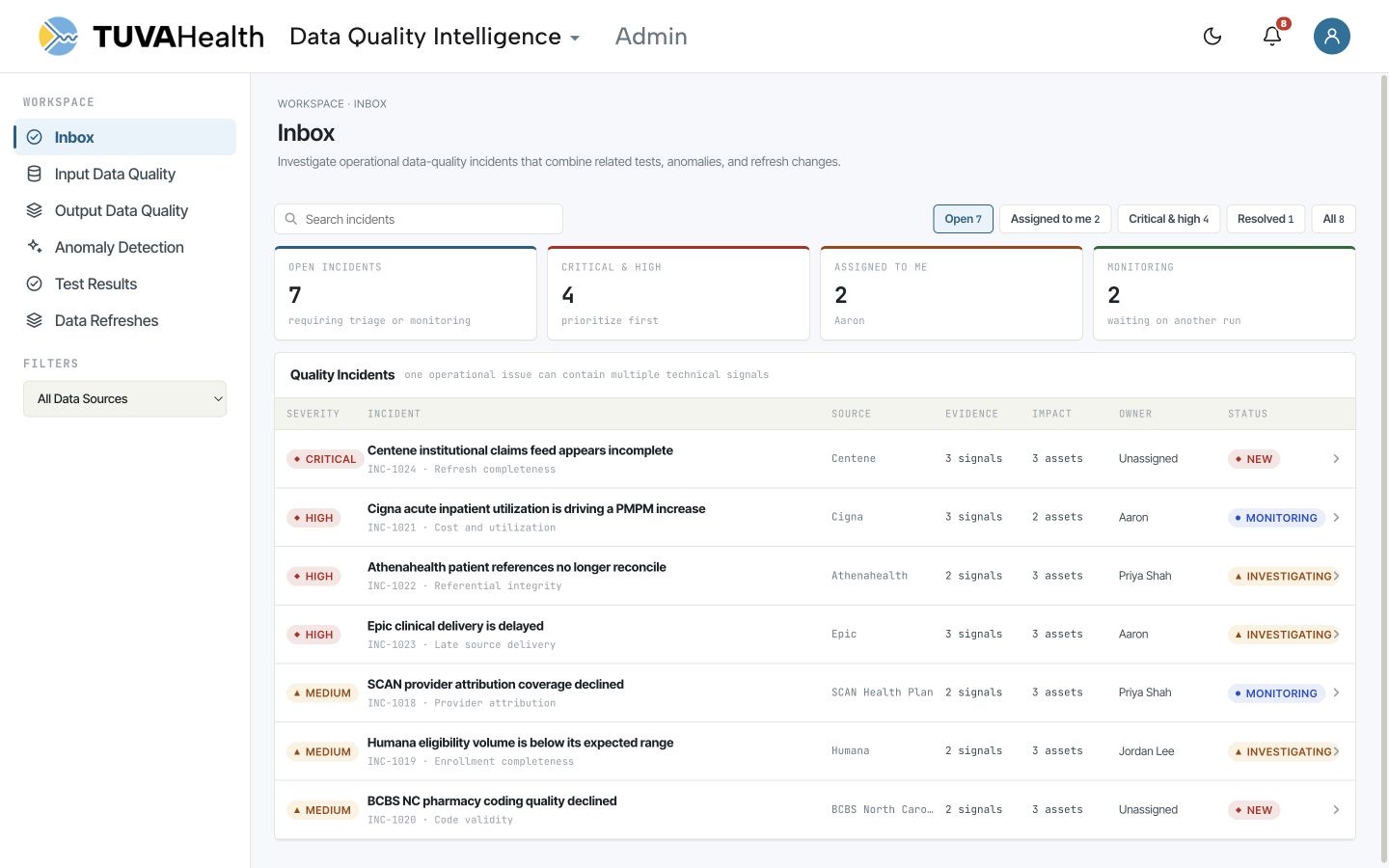
Give every team a shared, healthcare-specific way to detect, prioritize, and resolve data issues.
Track refreshes, schemas, required fields, data types, and source-level completeness.
Surface invalid, duplicated, inconsistent, and referentially broken records with precise counts.
Evaluate whether downstream outputs look complete and believable by healthcare domain.
Compare sources over time and focus engineering effort where quality risk is highest.
DQI creates a repeatable path from detection to validation.
Review current structural, logical, and analytical status in one place.
Drill into the affected table, test, or analytical domain to isolate the root cause.
Correct the source or transformation, rerun Tuva, and confirm the issue is resolved.
Walk through your current data sources and see how DQI would make quality risk visible to your team.